
You no longer need to replace your phone system to put AI on your front door. That is the single biggest shift in this market over the past twelve months, and it is why we keep getting the same question from customers: which standalone AI tool should we actually buy?
The honest answer is that "standalone" now covers two completely different categories of product. Comparing them as if they were one is how businesses end up either overpaying for capability they will never use, or underwhelming themselves with a tool that cannot do the job they actually need done.
The core question is not which product is best. It is which tier your problem sits in. Get that right first, and the product choice becomes straightforward.
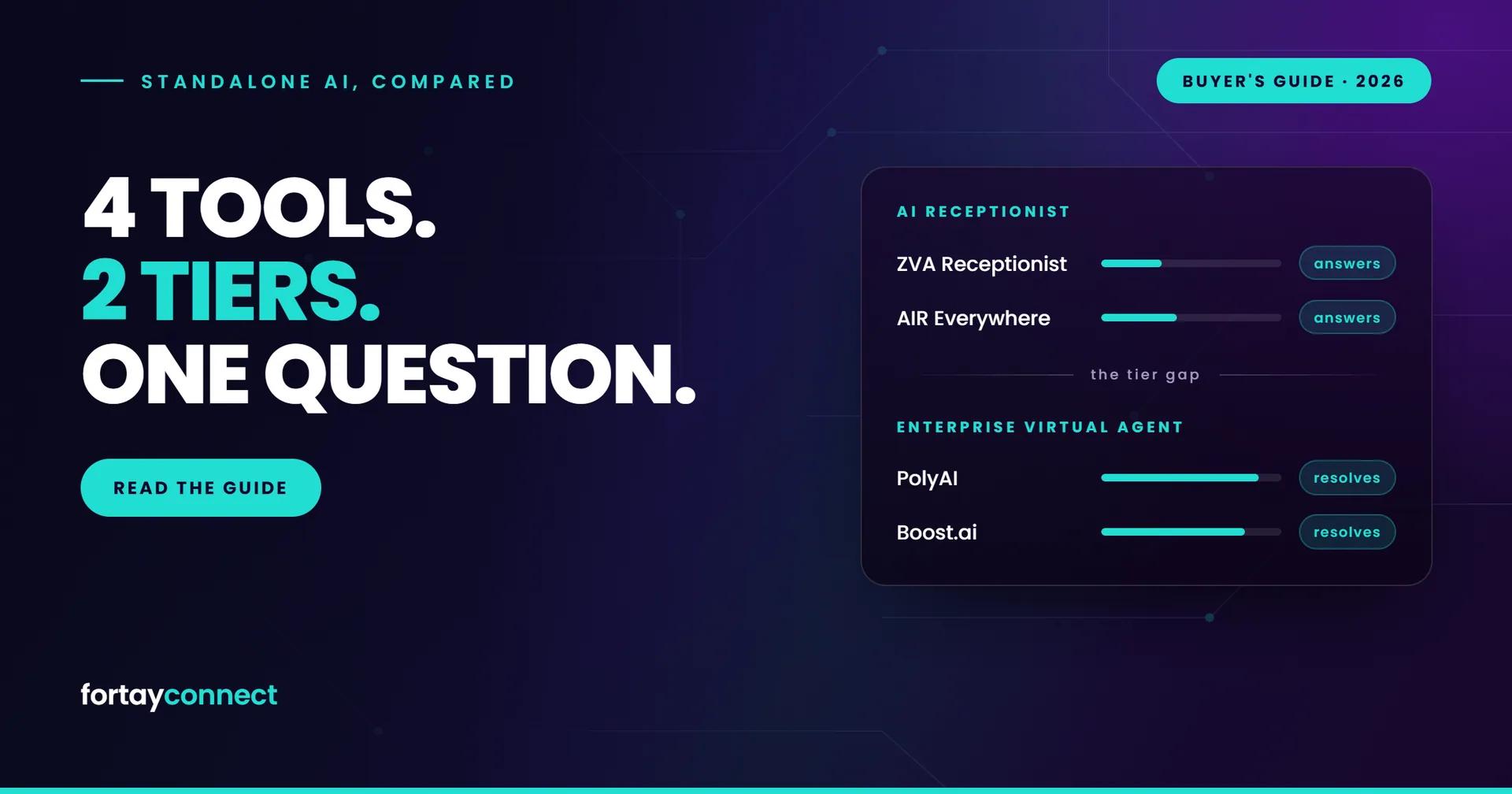
Before any feature talk, here is the distinction that matters, and where each of the four products we are asked about most actually sits.
The two tiers of standalone AI
The market has split cleanly into two tiers, and the gap between them is not just price. It is what the AI is actually designed to do.
Tier one: the AI receptionist
These products plug into whatever phone system you already run, whether that is on-premises kit, a cloud platform, or a plain business number. You buy them online, they are priced per 100 minutes, and they do one job brilliantly: answer every call, understand why the caller rang, route them to the right place, book appointments and capture leads. They are a front door, not a workforce.
What they do not do: resolve complex transactions. They cannot authenticate callers, take payments, service accounts or handle calls that require back-end system access. If a caller needs to change a booking, check an account balance or process a refund, a tier-one product will route them to a human. That is by design.
Tier two: the enterprise virtual agent
These are custom-scoped, managed deployments that resolve whole categories of calls without a human: taking payments, authenticating callers, changing bookings, servicing accounts. They are priced accordingly, typically on annual contracts with a minimum spend well into six figures, and they earn their keep when call volume is high and every contained call saves real money.
What they do not do: deploy in an afternoon. Tier-two products involve conversation design sessions, integration scoping, and professional services work. The trade-off for that complexity is genuine resolution rates, not just better routing.
Neither tier is better. They solve different problems at different price points. The expensive mistake is treating them as if they exist on the same spectrum.
Zoom Virtual Agent Receptionist (standalone)
Tier: AI receptionist
Zoom made ZVA Receptionist available as a standalone product on 9 July 2026, which means it now works with any existing phone system rather than requiring Zoom Phone. US pricing starts at $29.99 a month for 100 minutes, or $24.99 with annual billing, and there is a free trial for both new and existing customers. In the UK, expect volume-based pricing of roughly 20p per minute for voice as a guide, which at typical receptionist volumes makes it the most accessible entry point in this tier.
Two features stand out in practice:
- Live translation across 10+ languages, handled in real time during the call, not as a post-call transcript. For UK businesses serving diverse communities, this is not a nice-to-have.
- Warm transfer with AI summary: before connecting to a human agent, ZVA Receptionist summarises the conversation so the caller never has to repeat themselves. If you have ever explained your problem three times to three people, you understand why that matters.
It also sends key information via SMS post-call and includes built-in live transcription throughout.
One thing worth understanding: ZVA Receptionist is a rebrand of Zoom AI Concierge, and it is a tier-one product. It does not carry the same agentic capabilities as the full Zoom Virtual Agent, which uses multimodal LLM reasoning to resolve issues autonomously. For businesses already in the Zoom ecosystem, the path is clear: start with the receptionist, and if it proves the value of AI on your calls, the full Zoom CX platform sits behind it.
RingCentral AIR Everywhere
Tier: AI receptionist
RingCentral got to this idea first. AIR Everywhere was announced in August 2025 and became available in the UK in September 2025, priced from £32 a month including 100 minutes, with additional 100-minute bundles as you grow. Like ZVA Receptionist, it needs no RingCentral licence and connects to any phone system via SIP or call forwarding.
Its practical strengths are the ones that matter most to operations teams:
- Routing and spam filtering, so agents only pick up calls that need them
- Appointment booking directly into Google Calendar and Outlook during the call, without the caller being put on hold or transferred
- Lead capture into CRMs including HubSpot and Salesforce, mid-call
- Native support for British English, including regional variants
That last point sounds trivial until you have heard an American-trained AI mangle a Lancashire postcode or misread a Welsh place name. For UK businesses, native British English handling is a baseline expectation, not a differentiator.
One billing detail to model carefully: RingCentral bills AIR in half-minute chunks, which means usage can add up faster than expected if your average call duration is short and volume is high. If you are handling a large number of brief inbound calls, run your expected monthly minute volume before selecting a tier.
One thing to be clear about: AIR Everywhere is the receptionist product, not RingCentral's full agentic offering. If a salesperson implies it resolves complex service calls end to end, that is tier-two territory being sold as tier one.
PolyAI
Tier: enterprise virtual agent
PolyAI is a different animal entirely. It is enterprise voice AI, built on its own speech and language models, deployed as a managed service into your existing contact centre platform. Pricing is custom-quoted and billed per minute on annual contracts. PolyAI does not publish a rate card; third-party reviews consistently place minimum annual commitments around $150,000, with European first-year spend often higher once implementation and compliance requirements are factored in.
That number only makes sense in context: PolyAI is designed for organisations where thousands of calls a month cost far more than that in agent time.
What you actually get
What you get for it is genuine resolution, not routing. PolyAI agents:
- Authenticate callers against your systems
- Take payments within PCI DSS scope
- Manage bookings and service accounts
- Handle calls in more than 45 languages
Deployments are a services engagement, not a self-serve install. Conversation design sessions, integration scoping, and professional services work are all part of the process. Timeline estimates from independent reviews range from several weeks to a few months depending on complexity.
It is the product we point to when a customer says: "our agents spend all day on the same five call types." If those five call types are high-volume and transactional, PolyAI's containment rates will pay for the contract. If they are not, the maths does not work, and a tier-one product will serve you better at a fraction of the cost.
Boost.ai
Tier: enterprise virtual agent
Boost.ai comes at the same tier from a governance-first direction. It was built for regulated industries, which shows in the architecture: a hybrid of traditional NLU and generative AI that lets you decide precisely where the AI is allowed autonomy and where it must follow defined rails.
That control layer is not a technical detail. It is the product's core value proposition.
Why regulated industries choose Boost.ai
- Hybrid NLU and LLM architecture: you set the boundaries. The AI operates with full generative capability where appropriate, and follows scripted rails where compliance requires it.
- Spans chat and voice: unlike PolyAI's voice-first focus, Boost.ai handles both channels within the same platform and governance framework.
- ISO 27001 and ISO 27701 certified, with GDPR compliance built into the architecture, not bolted on.
- Named a Leader in Gartner's 2025 Magic Quadrant for Conversational AI, which matters when procurement teams need to justify a vendor choice to a risk committee.
Pricing is custom-quoted, in line with PolyAI. Boost.ai does not publish a rate card.
If you are a bank, an insurer, a law firm, or any organisation whose regulator reads your call transcripts, that control layer is not a nice-to-have. It is the reason Boost.ai wins deals in sectors where PolyAI's more open generative approach creates compliance risk.
The comparison at a glance
| ZVA Receptionist (standalone) | RingCentral AIR Everywhere | PolyAI | Boost.ai | |
|---|---|---|---|---|
| Tier | AI receptionist | AI receptionist | Enterprise virtual agent | Enterprise virtual agent |
| What it does | Answers, routes, translates live in 10+ languages, warm transfers with AI summary | Answers, routes, filters spam, books appointments, captures leads to CRM | Resolves calls end to end: payments, authentication, bookings, account servicing | Resolves across chat and voice with hybrid control over NLU and LLMs |
| Works with your existing phone system | Yes, no Zoom Phone required | Yes, no RingEX required | Yes, integrates with major contact centre platforms | Yes, deploys alongside existing infrastructure |
| UK pricing | ~20p per minute (guide); free trial available | From £32/month including 100 minutes | Custom quoted, per-minute billing | Custom quoted |
| How you buy | Online, free trial | Online, quick setup | Managed deployment, services engagement | Managed deployment |
| Compliance posture | Zoom platform standards | RingCentral platform standards | PCI DSS, HIPAA, SOC 2 | ISO 27001, ISO 27701, GDPR; Gartner MQ Leader 2025 |
| Right for you if | You want an AI front door this month | You want the same with strong calendar and CRM integration | High call volumes are costing serious money and you want them resolved | You are regulated and need control and auditability above all |
So which one?
Ask one question first: do you need calls answered, or resolved?
If the pain is missed calls and out-of-hours gaps
Start at tier one. Both ZVA Receptionist and AIR Everywhere cost less per month than one hour of a receptionist's time, and you can trial either without touching your phone system. The choice between them usually comes down to two factors:
- ZVA Receptionist if live multilingual translation and warm transfer summaries matter, or if you are already in the Zoom ecosystem and want a clear upgrade path.
- AIR Everywhere if calendar booking and CRM lead capture are the priority, or if you want a product that has been live in the UK market since late 2025 and has the British English handling to prove it.
If the pain is agent cost and repeat transactional volume
You are shopping in tier two, and the choice between PolyAI and Boost.ai comes down to a single question: is your priority voice resolution performance, or regulatory control and auditability?
- PolyAI if you have high call volumes, the same five transactional call types arriving thousands of times a month, and the containment economics to justify a six-figure annual contract.
- Boost.ai if you operate in a regulated sector where your compliance team needs to approve every scenario the AI can handle, and where ISO certification and Gartner validation are procurement requirements, not optional extras.
The mistake that costs the most
The worst outcome in this category is not choosing the wrong product within a tier. It is choosing the wrong tier entirely. Buying a tier-two product when tier one would have done the job means paying for resolution capability you will never use. Buying tier one when you needed tier two means the AI handles the easy calls and your agents are still buried in the hard ones, with no improvement to your cost-per-contact.
Both mistakes are avoidable. The answer comes from your call data: what types of calls are arriving, in what volume, and what resolution looks like for each. That is the analysis that determines your tier before you talk to any vendor.
Not sure which tier you need?
That is precisely the conversation we have every week. Fortay Connect works across all four of these products and every major platform underneath them. Our advice starts with your call data, not with whichever product we would rather sell.
If you want a quick reference before any conversation, download our two-page comparison guide below. It covers both tiers, all four products, and the questions to ask before you speak to any vendor.
Download the AI Standalone Buyer's Guide
Or if you would rather talk it through first: Book a call with Fortay Connect - it is free, and it usually saves money.