

An AI receptionist answers every inbound call the moment it rings, identifies what the caller needs, handles the routine questions itself, and passes anything requiring a person to the right one with a written summary attached. In a law firm the value is concentrated in two places: the calls that arrive when reception is closed, and the twenty identical questions a day that never reach a fee earner but still occupy someone.
What does an AI receptionist do in a law firm?
It picks up, greets the caller in your firm's name, and works out what the call is about. Most firms find the same pattern once they look at their own numbers. A large share of inbound calls are existing clients chasing an update on a matter, new enquiries wanting to know whether the firm handles a type of work, people asking about opening times or parking, and callers trying to reach a fee earner who is in court.
The routine questions get answered outright. Everything else gets routed, with the detail captured so the caller does not repeat themselves to the third person they speak to. An enquiry that arrives at nine on a Sunday evening is in somebody's inbox with a summary rather than sitting in a voicemail box until Monday.
For a general picture of how the technology works outside a legal setting, our AI receptionist guide for the UK covers the mechanics.
Which calls should it take, and which should it never touch?
The dividing line is advice. An AI receptionist should never answer a question about the merits of a matter, a limitation date, whether a claim is worth bringing, or anything a client could reasonably act on as legal guidance. That is not a technology limitation. It is a professional obligation, and any supplier relaxed about the distinction is one to be wary of.
What it handles well is everything before advice starts. Confirming the firm acts in a given area. Taking the details of a new enquiry and getting it to the right team. Telling a client which fee earner holds their matter and when that person is back. Booking a call back. Directing a caller to the right office.
Conflict checking is the interesting middle case. An AI receptionist can capture the names of the parties at the point of first contact, which is earlier and more consistently than most firms manage today, but the check itself belongs to your practice management system and to a person.
What happens to confidentiality and privilege?
This is the question that decides the purchase for most firms, and the honest answer is that it depends entirely on where the conversation is processed and what the provider retains.
The consequences became concrete this year. In Munir v Secretary of State for the Home Department, the Upper Tribunal observed that uploading confidential documents into open source AI tools waives client confidentiality and legal professional privilege. That case concerned an open tool rather than a contracted platform, but it sets the standard of care your firm will be judged against.
So the questions to put to any provider are specific ones. Where is the call transcribed and where is it stored. Whether the underlying model provider retains any of it and for how long. Whether your data is used for training, and whether that answer is contractual or merely a setting someone could change. What the retention period is and whether you control it. Whether UK or EU residency is a guarantee or a preference.
A supplier that answers those plainly is telling you something. So is one that does not.
What does an AI receptionist cost against a person on reception?
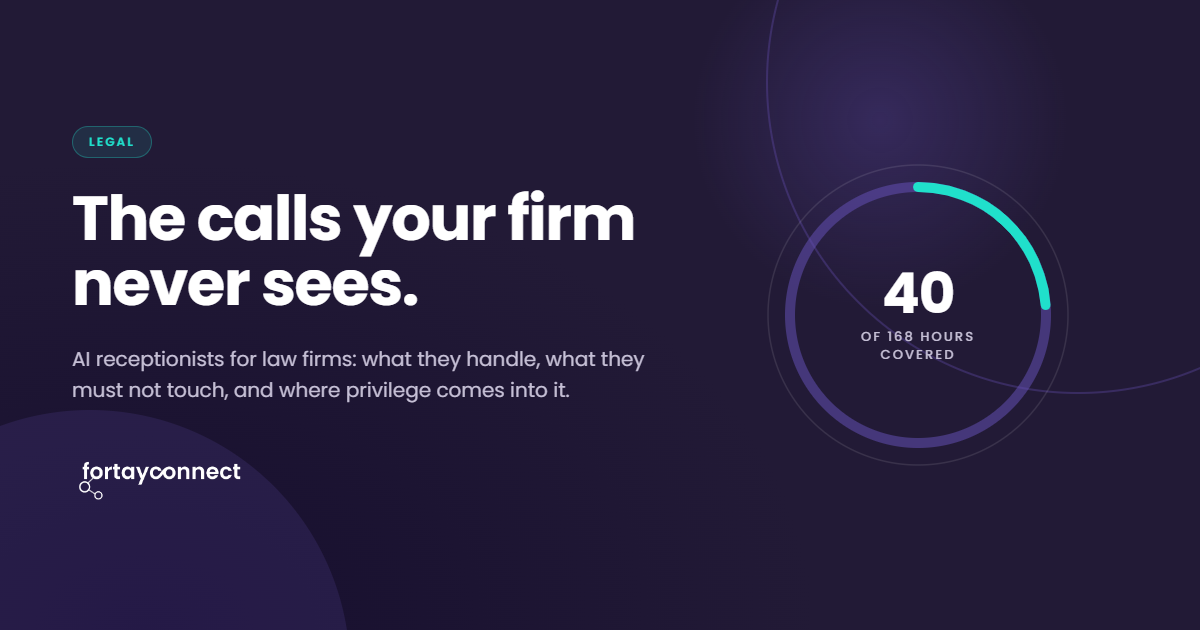
The honest comparison is not a headcount replacement, because almost no firm buys one to remove a receptionist. It is cover. A person covers roughly forty hours a week across one call at a time. The remaining one hundred and twenty eight hours, and every concurrent call above the first, currently go to voicemail or ring out.
We are not going to publish a per seat figure, because pricing varies by call volume and by the platform you already run, and a number lifted from an American price list is worse than no number. What we can say is the shape of it. Pricing is usually consumption based, so it moves with call volume rather than with headcount, and for most mid sized firms the cost of covering the out of hours window comes in well below the cost of adding a person to do it. Get a quote against your own call data rather than a benchmark.
The part that is easy to miss on the value side is the new enquiry. A firm that captures conveyancing or personal injury enquiries at eight on a Saturday, rather than losing them to whoever answered first, usually finds that one line of the business case carries the whole thing.
How do you tell whether it is working?
Four numbers, reviewed monthly. What share of calls were fully handled without a person. What share were routed correctly first time. How many calls arrived outside office hours and what happened to them. And how many callers asked to speak to a human immediately, which is the number that tells you whether people trust it.
Watch the last one carefully in the first month. A high rate is not a failure of the technology, it is usually a greeting that sounds like an automated menu rather than a receptionist, and it is fixable.
Ashtons Legal is one of our legal clients, and their move to cloud first communications and AI sets out how a firm of that size approached the change. Outside the legal sector, Bromcom moved to Zoom Contact Centre and Zoom Phone with a virtual agent in front of their helpdesk, and average engagement duration fell from fifteen minutes to twelve. Different sector, same mechanism.
Where to start
Pull a month of your own call data before you talk to anyone. How many calls came in, how many were answered, how many arrived outside hours, and what the top handful of reasons for calling actually were. Most firms have never looked, and the answer usually decides whether this is worth doing without anyone needing to sell it.