

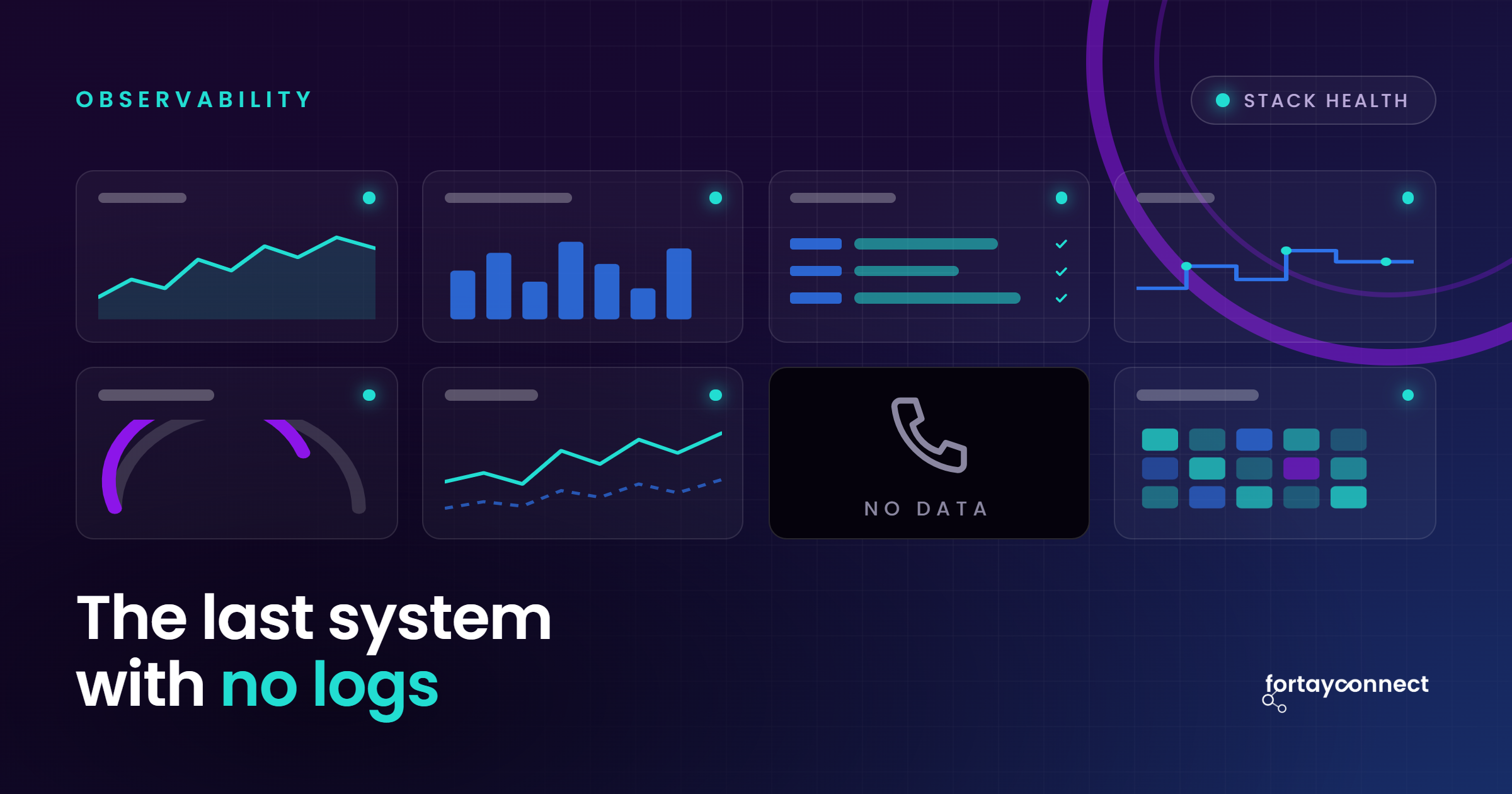
The Phone Is the Last System With No Logs
by
Fortay Connect
|
18th Aug 2026
Posts By Topics
- AI (20)
- News (17)
- Unified Communications (17)
- Contact Centre (16)
- Ring Central (13)
- Zoom (13)
- CX (12)
- Events (12)
- Virtual Agent (11)
- Avaya (7)
- Financial Services (7)
- GoToConnect (7)
- Contact Centre Consulting (6)
- Partners (6)
- Case Studies (5)
- Resources (5)
- Unified Communications Solutions (5)
- AI Meeting Assistant (2)
- AI Sales Analytics (2)
- Chatbot (2)
- Conversational Intelligence (2)
- Employee Communications (2)
- Legal (2)
- Microsoft Teams (2)
- Trends (2)
- Video (2)
- AI Companion (1)
- AI Receptionist (1)
- DialPad (1)
- Neurodiversity (1)
- Omnichannel (1)
- Sentiment Analysis (1)
- workvivo (1)
The Phone Is the Last System With No Logs
18 August 2026
If your phone system dropped every third call for a week, what would alert?
For the rest of the stack, the answer is straightforward: dashboards, on-call rotas, PagerDuty firing at 2am. For the phone, the answer is nothing. Missed calls do not throw errors. They do not appear in your logs, increment a counter, or trigger a Slack notification. They quietly become someone else's customer.
That is the blind spot. And for technology companies in particular, it is a strange one to have.
The blind spot
Most engineering teams at mid-market technology companies have invested seriously in observability. Distributed tracing, structured logging, alerting pipelines, SLO dashboards. The integration surface between services is instrumented. Latency is measured. Error budgets are tracked. The average technology company can tell you its API error rate to two decimal places, and cannot tell you how many calls rang out yesterday.
This is not a criticism. It is just a fact worth sitting with. The phone system occupies a category that almost nothing else in a modern stack does: it processes real interactions with real commercial consequences, and it produces no structured data by default. There is no audit trail. There is no equivalent of a 4xx response. When a call goes unanswered, the event does not exist anywhere in any system.
How it happened
This is not carelessness. It is history.
Telephony predates the observability culture that shaped modern software engineering. It was procured as infrastructure, installed, and left alone in the same way a building's electrical wiring is left alone. You expected it to work. You did not expect it to emit structured events.
Everything that came after telephony was built differently. CRM systems, ticketing platforms, analytics tools: these were born observable. They were designed to write records, expose APIs, and integrate. The assumption baked into their architecture is that data matters and should be accessible. Telephony made no such assumption because, when it was designed, that expectation did not exist.
There is also a cultural dimension specific to technology companies. Tech firms tend to assume that buyers behave like builders: they live in email, they explore product trials, they read documentation, they self-serve. That assumption shapes channel investment. It is also, in part, correct. Which is exactly why the calls that do arrive carry disproportionate information. The person who picks up the phone to contact a technology company in 2026 has already decided that digital channels are not sufficient for what they need to resolve.
The calls not being measured are the expensive ones
Think about who actually phones a technology company.
- An enterprise prospect wanting to speak to a human before signing a six-figure contract
- A customer mid-escalation, already past the point of trusting the support portal
- A renewal that is wobbling and needs reassurance before the quarter closes
- A partner on a deadline who cannot wait for an email thread
These are not routine enquiries. Instrumented channels, email, chat, self-serve portals, catch the high-volume, low-stakes traffic. The phone catches the moments that move revenue. It is the channel that activates when the stakes are high enough to justify the friction of a call.
The loss is self-concealing. A missed call creates no record anywhere. There is no failed request in your logs, no abandoned ticket in the queue, no bounce rate to investigate. The prospect simply calls a competitor. The escalation festers. The renewal churns. None of it surfaces in any dashboard, because the event that caused it never registered as an event at all.
This is what makes the blind spot commercially significant rather than merely interesting. You cannot measure the cost of what you cannot see.
What an observable voice channel looks like
Modern AI call handling, deployed properly, behaves like the rest of the stack.
It answers concurrently, so capacity is not a function of headcount. It resolves or routes with context, using natural language rather than menu trees, so callers reach the right outcome without navigating a DTMF hierarchy designed in 2009. And it produces data.
Every call becomes a structured record: intent, sentiment, outcome, routing decision. That record is written back into the CRM and ticketing systems already in place. The phone stops being a black box and starts being a source. You can query it. You can alert on it. You can build a dashboard that tells you what came in, what was resolved, what escalated, and what was missed.
This is what instrumentation looks like for voice. Not a separate reporting portal that no one opens. Structured data, written to the systems your team already uses, in the same way your API logs write to your observability platform.
Questions worth asking at architecture level
If you are evaluating any system that touches the voice channel, apply the same due diligence you would to anything else entering the stack. The questions are not complicated:
- What does it integrate with natively, and what does it write back? A system that captures call data but keeps it siloed is not solving the observability problem. The value is in the data reaching the systems that already matter: your CRM, your ticketing platform, your analytics layer.
- Where does call data live, and in which region? For UK businesses, data residency is a compliance question, not an afterthought. Confirm it before you commit.
- How does it degrade? Any system can fail. The question is whether it fails gracefully, routing to a human or fallback, or whether it fails silently and takes your inbound calls with it.
- What is the audit trail? You should be able to reconstruct what happened on any call. Intent, routing path, outcome, escalation trigger. If you cannot audit it, you cannot govern it.
- Does it sit in front of your existing telephony estate, or does it demand replacement? This is the most important question. The strongest deployments layer in front of the platform a business already runs, whether that is Zoom, RingCentral, Dialpad, or GoTo, rather than ripping it out and starting again. Replacement projects carry cost, risk, and timeline. Integration projects carry none of those at the same scale.
Worth deciding deliberately
Not every company needs to instrument its voice channel. If your inbound call volume is genuinely low and your current setup handles it without incident, that is a reasonable position to hold.
The argument here is narrower than "everyone should do this." It is that the phone should be a measured, integrated system that is incapable of failing silently, and that the decision about whether to change it should be made on data rather than assumption. Most teams that have looked at this honestly have found they did not have the data to make the decision either way. That, in itself, is the problem.
It is worth deciding deliberately at architecture level, before it becomes a procurement question driven by a missed renewal or a lost deal that nobody can trace back to anything.
Summary
- The phone is still the least observable part of many technology stacks.
- Missed calls matter most when intent is high and friction is high.
- Observable voice handling turns calls into structured data and audit trail.
- The right question is not whether to replace telephony, but how to layer in front of it safely.
- For many teams, the decision should be made on architecture and data, not assumption.
Fortay Connect helps UK businesses deploy AI call handling that integrates with the communications platforms they already run. If this is a conversation worth having, talk to the team.
Posts By Topics
- AI (20)
- News (17)
- Unified Communications (17)
- Contact Centre (16)
- Ring Central (13)
- Zoom (13)
- CX (12)
- Events (12)
- Virtual Agent (11)
- Avaya (7)
- Financial Services (7)
- GoToConnect (7)
- Contact Centre Consulting (6)
- Partners (6)
- Case Studies (5)
- Resources (5)
- Unified Communications Solutions (5)
- AI Meeting Assistant (2)
- AI Sales Analytics (2)
- Chatbot (2)
- Conversational Intelligence (2)
- Employee Communications (2)
- Legal (2)
- Microsoft Teams (2)
- Trends (2)
- Video (2)
- AI Companion (1)
- AI Receptionist (1)
- DialPad (1)
- Neurodiversity (1)
- Omnichannel (1)
- Sentiment Analysis (1)
- workvivo (1)