
Ask ten vendors what the difference is between a chatbot and an AI virtual agent and you will get ten different answers, most of them designed to make their product sound more advanced than it is. The terminology has become so muddied that buyers are making procurement decisions without a clear picture of what they are actually buying.
That matters. Because the gap between a chatbot and a true AI virtual agent is not a marketing distinction. It is a capability gap that determines what your technology can actually do, how your customers experience it, and what it costs your business when it gets things wrong.
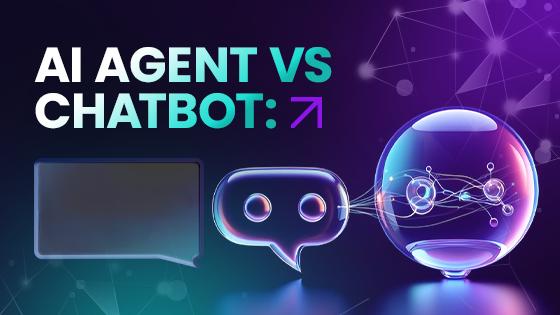
The clearest way to think about it: a chatbot is a tool that answers questions. An AI virtual agent is a system that handles outcomes. One responds, the other acts.
This piece cuts through the vendor noise and sets out what each technology actually is, where each one performs well, and how to decide which one your business needs, or whether you need both.
Quick answer: A chatbot answers questions by matching inputs to pre-set responses. An AI virtual agent understands context, takes action across connected systems, and resolves outcomes. One informs. The other acts.
How We Got Here: Why the Terms Got Confused
The confusion between chatbots and AI virtual agents is partly a product of how the market evolved. Early chatbots were simple rule-based systems, essentially decision trees dressed up with a chat interface. As natural language processing improved, chatbots got better at understanding varied phrasing, which made them feel more intelligent. Vendors started calling them "AI-powered" and, eventually, "virtual agents".
The problem is that improved language understanding does not change what a chatbot fundamentally is: a system that matches input to pre-defined output. It still cannot take actions. It still cannot reason about a situation it has not been explicitly programmed for. It still cannot handle a conversation that goes off-script.
What the market now calls an AI virtual agent is something meaningfully different:
- Built on large language models rather than intent-matching rules
- Capable of reasoning about novel situations, not just recognising familiar patterns
- Able to take actions across connected systems - updating records, processing requests, triggering workflows
- Designed to handle multi-turn conversations where the customer's need evolves in real time
- Capable of operating across voice and digital channels with consistent capability
The shift from chatbot to AI virtual agent is not an incremental improvement. It is a change in what the technology is designed to do.
Side-by-Side: What Each Technology Actually Does
The most useful way to understand the difference is to look at what each technology does when faced with the same customer scenario.
Scenario: A customer contacts a utility company. They want to change their direct debit date, but they also mention they are struggling financially and ask whether there are any support options available.
A chatbot handles this poorly. It might recognise "change direct debit" and route accordingly, but the mention of financial difficulty falls outside its scope. It either ignores it or produces a generic "speak to an agent" response. The customer's underlying need - support, not just a date change - goes unaddressed.
An AI virtual agent handles this differently. It processes both elements of the conversation, changes the direct debit as requested, identifies the vulnerability signal in the financial difficulty mention, and proactively surfaces the relevant support options, or escalates to a human agent with a summary of the full context.
| Capability | Chatbot | AI Virtual Agent |
|---|---|---|
| Handles pre-defined queries | Yes | Yes |
| Understands varied phrasing | Partial, NLP-dependent | Yes |
| Handles multi-turn conversations | Limited | Yes |
| Takes actions across systems | No | Yes |
| Adapts based on context or history | No | Yes |
| Detects emotional signals or vulnerability | No | Yes, with appropriate configuration |
| Operates on voice channels | Rarely | Yes |
| Learns and improves over time | No | Yes, with model updates |
| Handles novel, off-script queries | No | Yes |
Where Chatbots Still Make Sense
Chatbots are not obsolete. For specific, well-defined use cases, they remain a cost-effective and reliable option:
- High-volume FAQ deflection where the question set is finite and stable
- Pre-qualification and routing before handoff to a human agent or specialist system
- Structured data collection where information needs to be gathered in a predictable format
- Low-risk, transactional interactions where the consequences of an error are minimal
The key word is "defined". Chatbots perform well when the scope is narrow and the questions are predictable. Outside that boundary, they frustrate customers and generate escalations.
Where AI Virtual Agents Are the Right Choice
AI virtual agents are built for complexity, ambiguity, and action. They are the right choice when:
- Customer queries are varied and cannot be fully anticipated in advance
- The interaction requires access to live data or the ability to update records
- You need consistent performance across voice and digital channels
- Your business handles regulated or sensitive interactions where context matters (if you are in financial services, the compliance implications go deeper — see our guide to AI agent vs chatbot for FCA-regulated firms)
- You want to reduce agent workload on substantive tasks, not just basic queries
- Customer experience quality, not just deflection rate, is a success metric
The Cost of Getting This Wrong
Deploying a chatbot when the use case demands an AI virtual agent is one of the most common, and expensive, mistakes in contact centre technology. The consequences show up in three ways.
Customer Experience Degradation
Customers who hit the limits of a chatbot do not just abandon the interaction. They form a lasting negative impression of the brand. Poor self-service experiences push customers into more expensive human channels and reduce long-term loyalty. A chatbot that cannot handle a query does not save money, it shifts the cost and damages the relationship.
Agent Escalation Overload
When a chatbot cannot resolve a query, it escalates. If the chatbot is deployed on use cases it was never designed to handle, escalation rates are high, and agents receive handoffs with no context, forcing customers to repeat themselves. The operational cost saving from the chatbot is largely offset by the downstream agent handling cost.
Missed Revenue and Retention Opportunities
AI virtual agents can identify upsell and cross-sell moments, detect churn signals, and proactively offer solutions because they understand context. Chatbots cannot do any of this. Businesses that deploy chatbots on interactions where an AI virtual agent would add commercial value are leaving revenue on the table.
The real risk is not deploying the wrong technology - it is not knowing you have. Many businesses running chatbots believe they have AI virtual agents because their vendor used that language. The capability gap only becomes visible when customer experience data is examined honestly.
How to Decide What Your Business Actually Needs
The decision is not always binary. Many businesses benefit from both technologies deployed in parallel, chatbots handling the narrow, high-volume transactional queries, and AI virtual agents handling everything that requires judgement, context, or action.
The practical starting point is to audit your current or planned use cases against four questions:
- Is the query set finite and predictable? If yes, a chatbot may be sufficient. If queries vary significantly or evolve with customer context, you need an AI virtual agent.
- Does the interaction require taking action? If the system needs to update records, process requests, or trigger workflows, a chatbot cannot do it. An AI virtual agent can.
- Does context or history matter? If the right response depends on who the customer is, what they have done before, or what they said earlier in the conversation, you need an AI virtual agent.
- What is the cost of a failure? In regulated sectors, a missed vulnerability signal or an incorrect response carries compliance and reputational risk. The higher the cost of failure, the stronger the case for an AI virtual agent with robust oversight.
The Migration Path That Works
For businesses currently running chatbots who are evaluating AI virtual agents, the transition does not need to be a full replacement. The most effective approach:
- Keep the chatbot on the narrow, stable use cases where it performs reliably
- Deploy the AI virtual agent on the higher-complexity interactions where the chatbot is generating escalations or poor CSAT scores
- Use the data from both systems to identify where the AI virtual agent is delivering measurably better outcomes
- Expand the VA scope progressively as the evidence base builds
This approach manages risk, controls cost, and produces a clear commercial case for further investment.
The Better Buying Question
The wrong question is, "Do we need a chatbot or an AI virtual agent?"
The better question is, "Which customer interactions require intelligence, context, and action, and which do not?"
That framing immediately makes the buying decision clearer. It shifts the conversation away from vendor labels and towards operational reality. It also makes it easier to spot when a platform is being oversold.
For Fortay Connect's audience, that distinction matters. Buyers do not need more vague AI promises. They need to know which technology fits their use case, their customer journeys, and their commercial goals.
Fortay Connect helps UK businesses understand what AI virtual agent technology can actually do for their contact centre, and which platform is the right fit for their use case and scale. Contact us to discuss your requirements.
Frequently asked questions
What is the main difference between a chatbot and an AI virtual agent?
A chatbot answers questions by matching inputs to pre-set responses. An AI virtual agent goes further, handling context, multi-turn conversations, and actions across connected systems. In practice, a chatbot informs while an AI virtual agent resolves.
When is a chatbot still the right choice?
A chatbot works well when the use case is narrow, predictable, and low risk. It is a solid fit for FAQs, routing, structured data capture, and simple transactional queries where the scope is stable and the consequences of failure are limited.
When should a business choose an AI virtual agent instead?
An AI virtual agent is the better fit when customer queries are varied, context matters, or the interaction needs to trigger actions in connected systems. It is also the right choice for regulated or sensitive environments where missing context carries real risk.
Can a business use both chatbots and AI virtual agents?
Yes, and that is often the most practical setup. Many businesses use chatbots for high-volume, low-complexity queries and reserve AI virtual agents for interactions that require judgement, context, or action. That keeps costs down without forcing everything into one tool.
What happens if you use a chatbot where you really need an AI virtual agent?
You typically get poor handoffs, frustrated customers, and higher escalation costs. In more sensitive environments, you also risk missing vulnerability signals or retention opportunities, which can create compliance and revenue risk.